The Psychology of First Impressions: Why Your Digital Card Is Your Brand


Psychologists have studied first impression formation for decades. The consistent finding: humans form competence and trustworthiness judgments within the first 100-300 milliseconds of seeing a new face. By the time the conscious mind engages, the subconscious has already filed a verdict.
Your digital business card is a first impression delivery mechanism. Understanding the psychology behind how people judge it can meaningfully improve its effectiveness.
The Components of a First Impression
When someone opens your digital card, they are processing three layers simultaneously:
Layer 1, Aesthetic processing (0-300ms): Is this well-designed? Does it feel professional or cheap? Is it visually coherent?
Layer 2, Identity processing (300ms-2s): Who is this person? Are they like me? Do they seem competent?
Layer 3, Decision processing (2s+): What should I do? Should I contact this person? Should I save their details?
Most digital cards fail at Layer 1. A card that looks amateur signals "this person does not invest in their presentation", and that signal transfers to perceived quality of their services.
Design Signals and What They Communicate
| Design Element | Signal Sent |
|---|---|
| Professional headshot | Confidence, accessibility, human connection |
| Inconsistent fonts | Carelessness, amateur design |
| Brand-consistent colors | Intentionality, established business |
| Too much information | Poor judgment, inability to prioritize |
| Clear white space | Sophistication, confidence |
| Low-quality photo | Cutting corners, doesn't care about presentation |
| Missing photo | Impersonal, hiding something |
| Well-written tagline | Self-awareness, communication skill |
The Face Effect
The presence of a professional headshot is the single most impactful element of a business card from a trust-formation perspective. Research on face perception shows:
- Faces activate emotional processing faster than any other visual stimulus
- Competence judgments from faces occur within 100ms
- Perceived warmth (approachability) from faces affects trust formation more than perceived competence in service-based relationships
For Arabic-speaking professionals, there is sometimes hesitation about adding photos, cultural norms vary. In MENA professional markets, having a professional photo is increasingly standard and expected across all genders.
Cognitive Load and Conversion
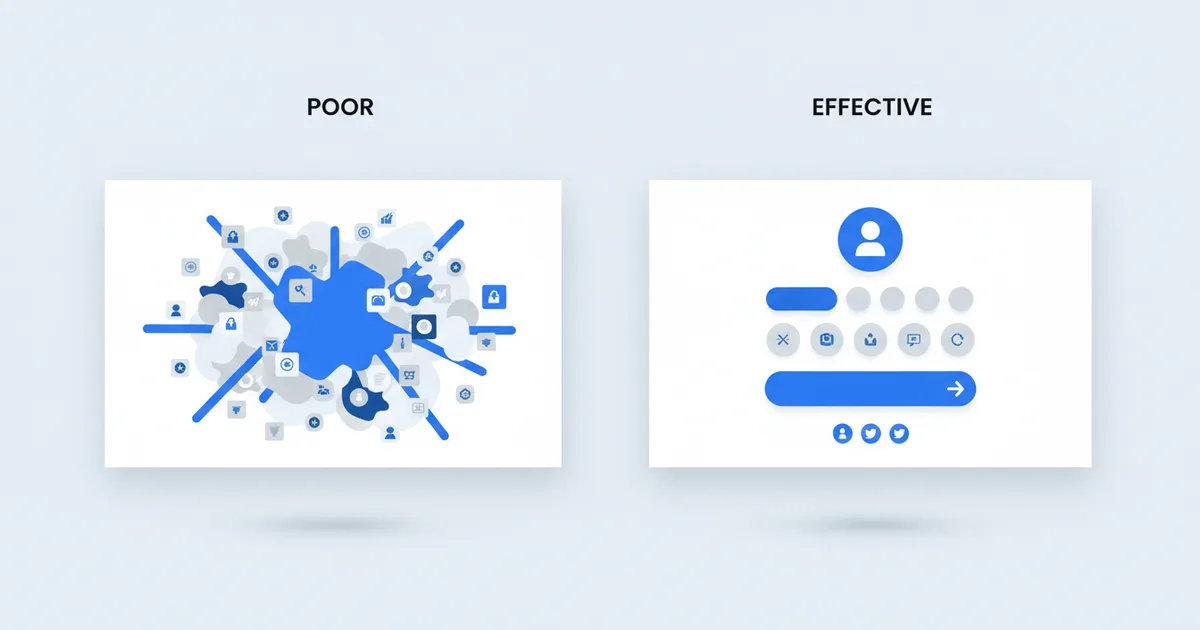
The more choices a visitor has to make, the less likely they are to make any of them. This is cognitive overload, and it is the reason most digital cards underperform.
| Card Complexity | Cognitive Load | Action Taken |
|---|---|---|
| 1 CTA, clean design | Low | High action rate |
| 3-5 CTAs, some visual hierarchy | Medium | Medium action rate |
| 10+ links, no hierarchy | High | Low action rate ("I'll look at this later") |
"I'll look at this later" translates to "I'll never look at this."
Color Psychology in the MENA Context
Color associations have cultural specificity. In the MENA professional market:
| Color | Professional Association | Use in Card |
|---|---|---|
| Navy blue | Trust, stability, finance | Ideal for lawyers, consultants, finance |
| Green | Growth, Islam, healthcare | Doctors, wellness, Islamic finance |
| Gold/amber | Prestige, luxury | Premium services, hospitality |
| Black | Power, luxury, exclusivity | Executive, high-end creative |
| White | Cleanliness, healthcare | Medical professionals |
| Red | Energy, urgency | Use sparingly, can signal aggression |
Scaanme's templates are color-coordinated for different professional contexts. Starting with a profession-appropriate template is faster and more effective than building from scratch.
The Authority Heuristic
People use credentials, affiliations, and recognizable brand associations as shortcuts for competence evaluation. On your digital card:
- Institutional affiliations (companies, universities) signal validated credibility
- Certifications and licenses signal verified expertise
- Client logos (if you have permission to display them) signal market trust
- Publication links signal intellectual authority
The strategic placement of these signals above the fold (visible without scrolling) means they are processed as part of the first impression rather than discovered later.
Applying This to Your Scaanme Card
- Photo first: If you do not have a professional headshot, get one before launching your card. Nothing else matters as much.
- Tagline precision: Your tagline should communicate competence AND relevance in under 10 words. "Corporate lawyer for MENA tech startups" passes the 10-word test and communicates both.
- Visual hierarchy: One button more prominent than all others. This is your primary CTA and it gets the action.
- Social proof placement: Place a credential, affiliation, or testimonial in the first scroll. Let it be seen before the visitor decides to leave.
- Color coherence: Choose brand colors that align with your professional context and apply them consistently throughout your card.