WhatsApp Business API: Cost and a Simpler Alternative

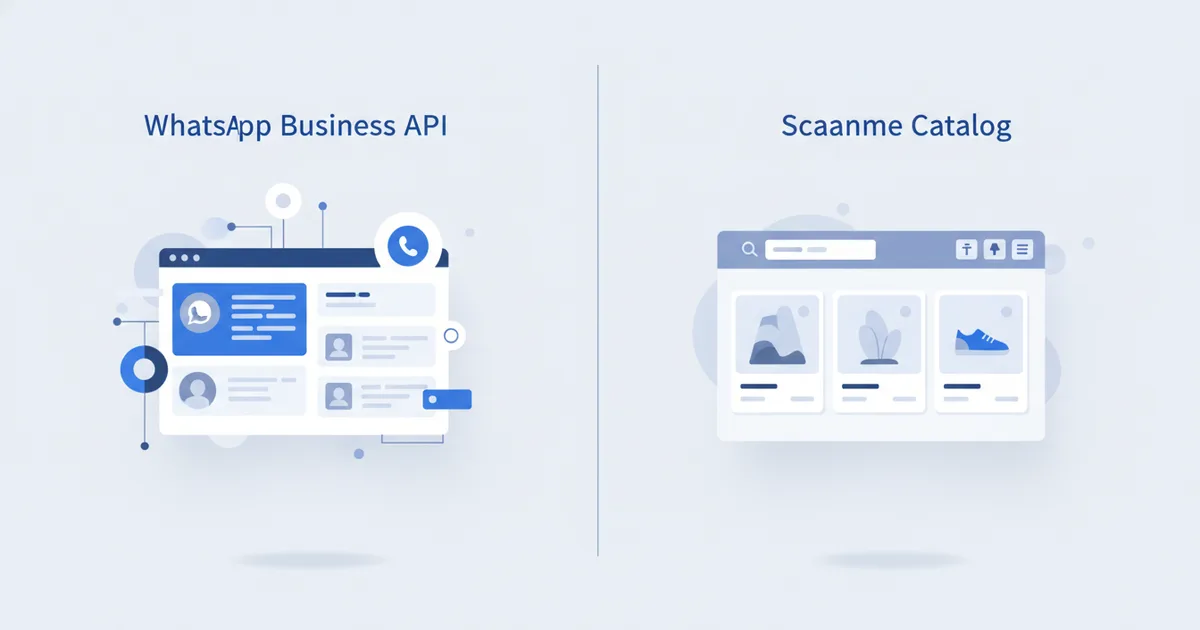
How much does the WhatsApp Business API cost? Meta bills per delivered template message, with rates that vary by message category and destination country, and since July 1, 2025 marketing and utility messages are charged per message rather than per 24-hour conversation. On top of Meta's fees, a Business Solution Provider (BSP) adds monthly platform charges, so small businesses typically land between $50 and $500+ per month. The simpler alternative for a small shop is a WhatsApp store: a ready-to-sell catalog that routes orders through WhatsApp with zero per-message fees. Choosing wrong costs you either money or capability.
What Each Option Actually Is
WhatsApp Business API is a programmable messaging layer. It lets you send template messages at scale, build chatbots, and integrate with CRMs. It requires a BSP, approved message templates, and per-message fees published on Meta's official rate card. It is built for companies that need to send 10,000+ messages a month to opted-in customers.
Scaanme WhatsApp Store is a product catalog hosted on your digital card. Customers browse your items, add to cart, and the order is sent as a formatted WhatsApp message to your number. You chat from there. Zero developer work, zero per-message fees, live in 10 minutes.
Direct Comparison
| Criteria | WhatsApp Business API | Scaanme Store |
|---|---|---|
| Setup time | 2-8 weeks (BSP approval process) | Under 10 minutes |
| Developer required | Yes, or expensive BSP setup fees | No |
| Monthly cost | $50-500+ (BSP fees + per-message) | Free plan; paid plans from $7.99/month |
| Outbound messaging | Yes, bulk campaigns | No |
| Product catalog | Via separate catalog API | Built-in, visual |
| Order workflow | Custom build | Pre-built cart + WhatsApp handoff |
| Customer-initiated chat | Yes | Yes |
| Analytics | BSP dashboard (varies) | Built-in Scaanme analytics |
| NFC/QR entry point | No | Yes, same profile |
| Booking system | No | Integrated |
When to Choose WhatsApp Business API
You need the API if:
- You send promotional broadcasts to thousands of opted-in customers
- You need a chatbot to handle first-level customer support
- You have an in-house developer or can afford a BSP integration fee
- You are running a major e-commerce operation with automated order flows
In the Middle East, this typically means: established retailers, banks, airlines, or brands with dedicated tech teams.
When to Choose a WhatsApp Store
The Scaanme store wins for:
- Freelancers and service providers selling packages
- Small retailers: boutiques, bakeries, gift shops in Egypt, Jordan, KSA
- Consultants listing services with pricing
- Anyone who wants to be selling within an hour
The customers are already there: around 72% of Egyptian internet users are on WhatsApp according to Statista's January 2024 data.
Most small businesses in MENA do not need outbound campaigns. They need inbound buyers to find a catalog and start a conversation.
That is exactly what the Scaanme store enables, and it is why boutiques in Egypt and Saudi Arabia run entire businesses on this model.
Can You Use Both?
Yes, and some businesses do. The typical hybrid setup:
- Scaanme store handles the product catalog, new customer acquisition, and booking, all discoverable via QR/NFC
- WhatsApp API handles outbound re-marketing to existing customers who opted in
This makes sense once you grow past ~500 active customers and need to proactively reach them with promotions.
There is also a middle path that needs no API at all: turn your card into an Apple or Google Wallet pass. Customers save it to their phone, and a Holder Broadcast pushes a lock-screen notification to every holder at once, a new arrival or a seasonal offer, with no per-message fee and no BSP. It does not replace true bulk campaigns to a large opted-in list, but for most small shops it covers the one job they wanted the API for.
Real-World Examples
Jewelry boutique in Riyadh, sells custom pieces, no shipping, WhatsApp negotiation required. Scaanme store perfect. API would be overkill.
Online grocery in Kuwait, 50,000 customers, daily promos, automated order tracking. API is the right call.
Fitness coach in Dubai, sells session packages, needs booking + catalog. Scaanme store handles both in one place.
Regional delivery company, tracks 5,000 parcels via WhatsApp notifications. Needs API.
Cost Reality Check
If you are spending $200/month on a BSP to manage a 2,000-contact list and send weekly promos, ask whether Scaanme's catalog delivers better ROI for inbound discovery. The API pricing model is per-message and scales with volume, meaning that as your business grows, your messaging costs grow proportionally.
Scaanme's pricing does not change based on how many people view your catalog: a free plan is available, with paid plans from $7.99/month on the pricing page.
FAQ
How much does WhatsApp Business API cost per month?
Meta charges per delivered template message at country-specific rates, and your BSP adds its own platform fee. For a small business sending regular campaigns, total costs typically run from $50 to $500+ per month depending on volume and market.
Do I need a developer for the WhatsApp API?
Practically yes. You need BSP onboarding, template approval, and integration work. A WhatsApp store needs none of that: you upload products and share a link.
Can I sell on WhatsApp without the API?
Yes. A catalog-based WhatsApp store sends each order as a formatted WhatsApp message to your normal business number. You negotiate, confirm, and arrange payment in the chat.
Is the free WhatsApp Business app enough for a shop?
It handles chat well but its catalog is basic and lives only inside WhatsApp. A digital-card storefront adds a browsable catalog, QR and NFC entry points, booking, and analytics on top of the same WhatsApp number.